

Machinery Loan for Business Growth
Running a manufacturing or production business often requires the right machines at the right time. A machinery loan helps businesses purchase new machines or upgrade existing ones without putting pressure on daily cash flow.
With a machinery loan, you can spread the cost of equipment over easy monthly EMIs instead of paying a large amount at once. This allows your business to continue operations smoothly while improving production capacity.
Introduction
A machinery loan is a type of business loan specially designed to finance industrial and commercial machines. It is commonly used by MSMEs, manufacturers, and processing units to invest in modern equipment that improves efficiency and output.
Businesses use a machinery loan to replace old machines, expand production lines, or set up new units. Since the machinery itself is usually considered as security, this loan often comes with better terms compared to unsecured business loans.
If your business needs reliable funding to support manufacturing or operational growth, a machinery loan can be the right solution.
What is a Machinery Loan?
A machinery loan is a type of business loan used to purchase new machines or upgrade existing machinery for business use. This loan is mainly taken by manufacturing units, factories, and production-based businesses.
With a machinery loan, the lender provides funds to buy machines such as manufacturing equipment, processing units, or industrial tools. The loan amount is repaid in monthly EMIs over a fixed period.
A machinery loan helps businesses improve productivity without paying the full cost of machines upfront. In most cases, the machinery itself acts as security, which makes this loan more affordable than unsecured business loans.
Recent Posts
How Can I Utilise the Loan Against Property?
Businesses often take a machinery loan when they want to expand production, replace outdated machines, or improve work efficiency. This type of financing supports long-term business growth by making modern equipment accessible.
In simple words, a machinery loan helps businesses invest in the right machines while keeping cash flow balanced.
Why Choose a Machinery Loan?
Many businesses choose a machinery loan because it helps them grow without disturbing daily cash flow. Buying machines with full payment can be difficult, especially for small and medium businesses. A machinery loan makes this easier.
One key reason is easy monthly EMIs. Instead of paying a large amount at once, businesses can spread the cost over time. This helps in better cash flow management.
A machinery loan also helps improve production capacity and efficiency. New or upgraded machines allow businesses to work faster, reduce errors, and increase output.
Another advantage is better use of funds. Businesses can save their working capital for daily expenses while using a machinery loan to invest in equipment.
Since the machinery itself is usually taken as security, a machinery loan often comes with lower interest rates compared to unsecured business loans.
Overall, a machinery loan supports planned growth and helps businesses stay competitive in the market.
Common Uses of a Machinery Loan
A machinery loan is mainly used for business needs where new machines or equipment are required to improve operations. Many businesses take this loan for planned investment in production.
Hot Topics
Business Ideas
Business Ideas in Goa
Business Ideas in Rajasthan
Business Ideas in Gujarat
MSME Business Ideas
One common use is the purchase of new machinery. Businesses buy modern machines to increase production speed, improve quality, and meet growing demand.
Another use is replacement of old or outdated machines. Old machines often increase maintenance costs and reduce efficiency. A machinery loan helps upgrade equipment without affecting cash flow.
Businesses also use a machinery loan for expansion of manufacturing units. When production needs increase, additional machines are required to support higher output.
A machinery loan is also useful for setting up a new factory or workshop. It helps cover the cost of essential machines required to start operations.
Overall, a machinery loan supports smooth production, better efficiency, and long-term business growth.
Machinery Loan vs Equipment Loan
Many business owners think that a machinery loan and an equipment loan are the same. Both are used to buy assets for business, but their purpose and scope are slightly different.
A machinery loan is mainly used for industrial and manufacturing machines. It is suitable for factories, production units, and processing businesses that use heavy or specialized machinery.
An equipment loan, on the other hand, is used for a wider range of business equipment. This may include office equipment, medical devices, IT systems, or light commercial tools.
| Point | Machinery Loan | Equipment Loan |
|---|---|---|
| Purpose | Industrial & production machines | General business equipment |
| Best for | Manufacturing units | Service & commercial businesses |
| Asset type | Heavy or specialized machinery | Light to medium equipment |
| Usage | Production & processing | Operations & services |
In simple words, choose a machinery loan if your business depends on manufacturing or production machines. Choose an equipment loan if you need funding for general business tools or office-related equipment.
Eligibility Criteria for Machinery Loan
To apply for a machinery loan, a business needs to meet some basic eligibility conditions. These conditions help lenders understand whether the business can repay the loan comfortably.
First, the business should be operational for a minimum period. Most lenders prefer businesses that have been running for at least 1 to 3 years.
Second, the business should have a stable turnover. Regular income shows that the business can manage monthly EMIs of a machinery loan.
Third, the applicant should have a good credit profile. A clean repayment history improves approval chances and may also help in getting better loan terms.
Fourth, the business should have proper bank transactions. Bank statements help lenders review cash flow and financial discipline.
This machinery loan eligibility applies mainly to manufacturing units, factories, processing units, and MSMEs. Final eligibility may vary based on lender policies and the type of machinery being financed.
Documents Required for Machinery Loan
To apply for a machinery loan, businesses need to submit a few important documents. These documents help lenders verify business details and assess repayment capacity.
Identity and address proof of the applicant is required. This usually includes PAN card and valid address proof.
Business registration documents are needed to confirm that the business is legally registered. This may include GST registration, Udyam registration, or trade license.
Bank statements of the last 6 to 12 months are required. These statements show business income, expenses, and cash flow patterns.
A quotation or invoice of the machinery to be purchased is also required. This helps lenders understand the machine cost and loan amount.
In some cases, financial documents such as profit and loss statements or income tax returns may be requested, depending on the loan size and lender policy.
Submitting complete and correct documents helps in faster approval of your machinery loan.
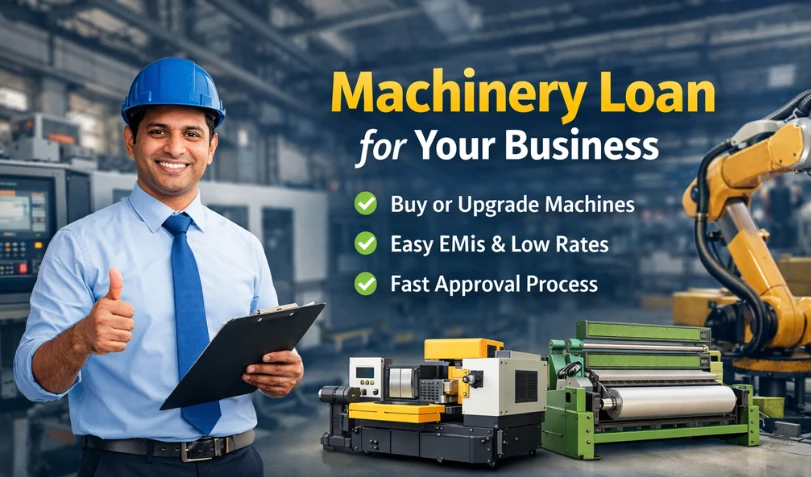
Key Features of a Machinery Loan
A machinery loan comes with features that make it easier for businesses to invest in machines without affecting regular operations.
One key feature is the asset-based financing structure. The machinery being purchased is usually taken as security, which helps businesses get better loan terms compared to unsecured loans.
Another important feature is the fixed repayment structure. A machinery loan is repaid through monthly EMIs over a fixed tenure, making it easier to plan finances.
A machinery loan also offers flexible repayment tenure, depending on the business profile and type of machinery. This allows businesses to choose a repayment period that suits their cash flow.
The loan amount is generally based on the cost of machinery and business capacity. This ensures that funding matches actual business needs.
Overall, a machinery loan provides structured funding, predictable repayment, and long-term support for manufacturing and production growth.
Industries We Support with Machinery Loans
A machinery loan is useful for many industries where machines play a key role in daily operations and growth. We support a wide range of business sectors with machinery financing solutions.
Manufacturing units commonly use machinery loans to increase production capacity and improve efficiency. New machines help reduce manual work and improve output quality.
Textile and garment businesses use machinery loans to purchase weaving, stitching, or processing machines to meet market demand.
Food processing units take machinery loans to invest in processing, packaging, and storage equipment required for smooth operations.
Printing and packaging businesses use machinery loans to upgrade printing machines and improve production speed and quality.
Engineering and fabrication units also benefit from machinery loans for tools, cutting machines, and heavy equipment needed for precision work.
A machinery loan supports both small and growing industries by making modern machines affordable through structured repayment.
Frequently Asked Questions :
What is a machinery loan?
Who can apply for a machinery loan?
Is a machinery loan secured or unsecured?
What is the repayment tenure of a machinery loan?
What documents are required for a machinery loan?
Can MSMEs get a machinery loan?
Is government subsidy available on machinery loans?
Need Funding to Upgrade or Buy New Machinery?
Modern machines help businesses grow faster and work more efficiently. A machinery loan allows you to invest in the right equipment without putting pressure on daily cash flow. Apply today and get expert guidance to choose the right machinery financing for your business needs.
Apply For Business Funding
Recent Posts
Contact Us
1204 GD – ITL Building, B- 08,
Netaji Subhash Place, Delhi-110034
Email: ceo@nkbkredit.com
Phone: +91 7503211000,
+91 9654981031
Services
Working Capital Loan
Business Term Loan
Unsecured Business Loan
Machinery Loan
Important Links
Disclaimer
This website functions as a business loan–focused advisory channel supporting individuals and businesses seeking structured funding solutions. Advisory, documentation, and lender coordination services are provided by NKB Kredit Solutions Pvt. Ltd, a registered Indian company offering business finance advisory services.
Copyright © 2026 All Rights Reserved by NKB Kredit Solutions (P) Ltd.